

Surprising stat: a majority of DeFi losses are not from “clever” hacks but from users approving or signing transactions they don’t understand. That’s the problem Rabby Wallet aims to address: not by promising invulnerability, but by shifting what the user signs from an opaque blob of data to an intelligible economic preview. For experienced DeFi users operating across multiple EVM chains, that difference can be the line between a recoverable mistake and permanent loss.
This piece unpacks how Rabby’s install and download paths fit into a wider security posture, how its transaction simulation engine actually works in practice, where it helps most, and where it cannot — and why those limits matter for U.S.-based DeFi traders and custodians. I’ll also compare the mechanics to alternatives and finish with decision heuristics you can reuse when choosing a multi-chain wallet.
Install and download: pick the right surface for your use-case
Rabby is distributed as a Chromium extension (Chrome, Brave, Edge), a mobile app for iOS/Android, and a desktop client for Windows/macOS. The installation choice isn’t neutral: browser extensions are the most convenient for interacting with web dApps but they expose you to browser-level risks (malicious extensions, clipboard attacks, browser vulnerabilities). Desktop and mobile clients reduce some attack vectors at the cost of convenience and, depending on your OS security posture, different exposures.
For institutional users or multisig setups, Rabby integrates with enterprise tools like Gnosis Safe and custody providers, which changes the threat model: fewer single points of browser compromise, more emphasis on correct multi-signer workflow. For hardware-first security, Rabby supports Ledger, Trezor, Keystone and others — pairing a hardware device with Rabby’s UI preserves the hardware’s private-key protections while adding Rabby’s pre-transaction analysis.
If you want to see Rabby’s official landing material before installing, start here — but treat that as product documentation, not a security audit. Always verify extension signatures and distribution channels and prefer direct stores (Chrome Web Store, App Store) while recognizing those platforms have their own risk and review limitations.
Mechanism: what transmission simulation actually does
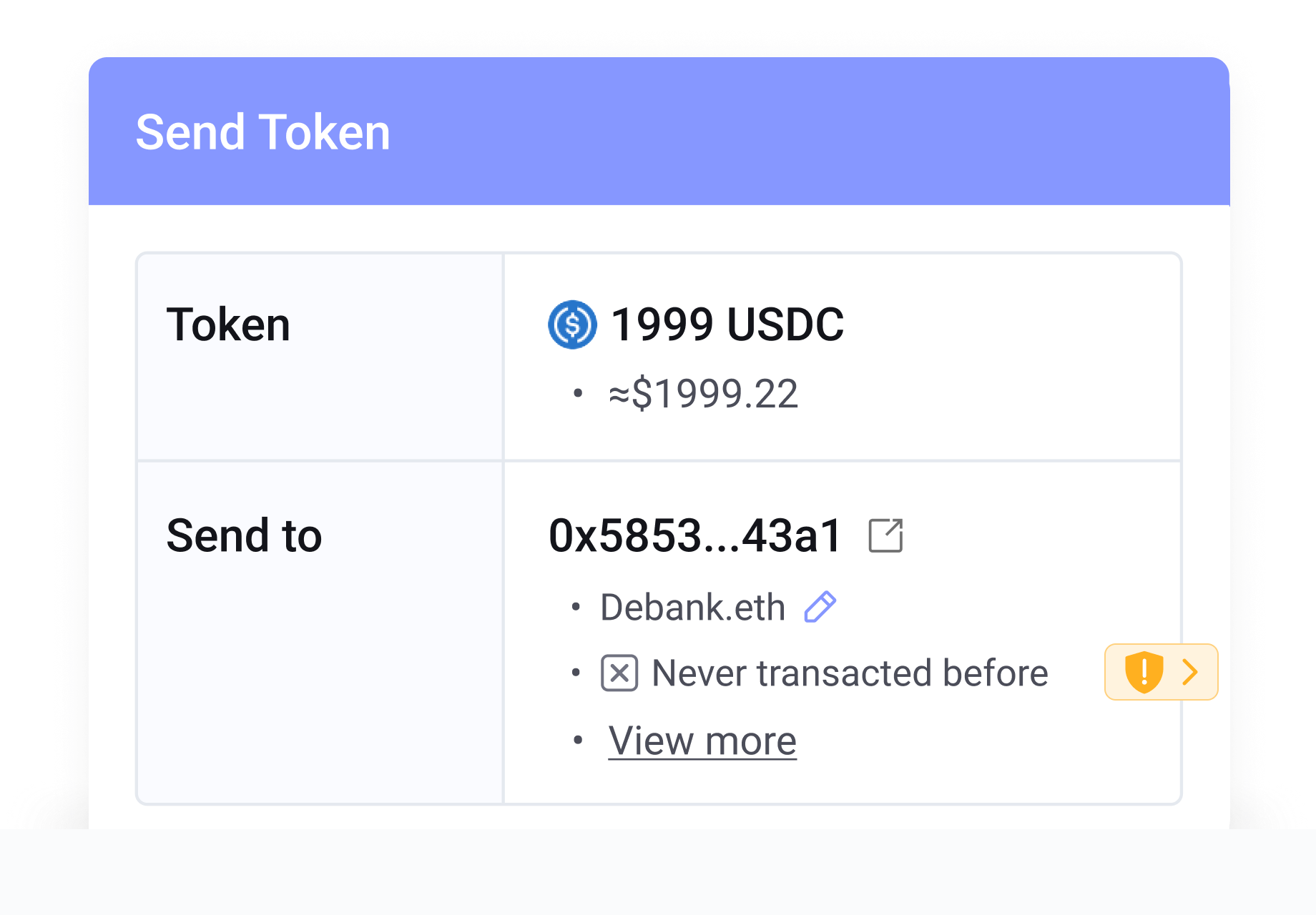
“Transaction simulation” is often used like a buzzword. Mechanism-level: when a dApp asks your wallet to sign a transaction, Rabby first constructs the raw transaction data and then runs a local simulation against a read-only node or a forked state to execute the transaction off-chain. The result is a deterministic estimate of state changes — token transfers, swaps, approvals, gas consumed — expressed as balance deltas and expected fees. That output is what Rabby surfaces to you instead of just the ABI call names and hex payloads.
Two important details power the usefulness. First, the simulation happens before signing, so it stops “blind signing”: you see a numerical preview of outcomes instead of cryptic calldata. Second, Rabby’s risk scanner overlays additional metadata: known hacked contracts, suspicious approval patterns, or non-existent recipient addresses. Those are heuristic signals, not absolute proofs, but combined with balance deltas they form a stronger decision signal than either alone.
Why this helps: many exploit patterns depend on users giving infinite token approvals or signing transactions that perform additional actions beyond what the UI advertised. Seeing that your ERC-20 approval will allow a contract to move specific token amounts — or seeing that a swap will drain unexpected tokens — changes the cognitive posture from optimistic clicking to deliberate consent.
Where the simulation wins — and where it doesn’t
Wins: the simulation is particularly effective when the danger is semantic (you misread the UI) or when the transaction has predictable, local effects (swaps, transfers, approvals on familiar contracts). It reduces accidental over-approvals and forces users to reconcile numeric outcomes with intent.
Limits: simulations are only as accurate as the state and node they run against. They can miss complex cross-contract flows that rely on off-chain data, oracle-fed conditions that can change between simulation and chain inclusion, or reentrancy behaviors triggered by gas ordering differences. In addition, simulations cannot protect your seed phrase or prevent social-engineering attacks outside the signing flow.
Trade-off: relying on simulation improves guardrails but can create a false sense of absolute safety. A robust mental model is: simulation = “probabilistic audit,” not “mathematical proof.” When an operation touches many contracts or depends on mutable external state (price oracles, timelock windows), treat simulation as one signal among others (contract audit history, community intelligence, hardware confirmation, revocation tools).
Comparative mechanics: Rabby vs. the common alternatives
MetaMask, Trust Wallet, and Coinbase Wallet are familiar points of comparison. Mechanically, Rabby distinguishes itself by integrating simulation and automatic network switching into the signing flow. MetaMask leaves more interpretation to the user and third-party plugins; Coinbase Wallet leans on ecosystem trust and UX; Trust Wallet emphasizes mobile convenience. Rabby’s edge is not magic — it’s a different distribution of effort: shifting work from user interpretation to machine-readable simulation and screening.
But compare costs: Rabby lacks a fiat on-ramp and in-wallet staking. If your workflow depends on buying crypto with USD in-app or staking without leaving the wallet, Rabby forces an external step. The wallet’s strength is safer signing across >90 EVM-compatible chains and an approval revocation tool that reduces long-tail exposure if you ever misapprove a contract.
Operational heuristics for DeFi power users
Here are practical rules that synthesize Rabby’s mechanisms into decisions you can reuse:
- Always pair Rabby with a hardware wallet for high-value accounts. Simulation helps, but private-key isolation is the foundational protection.
- Use the approval revocation tool regularly. Treat token approvals like open tabs — close ones you don’t need.
- When simulation shows complex multi-token deltas, pause. Recheck contract addresses, expected slippage, and oracle dependencies; if uncertain, test with minimal amounts.
- For institutional flows, combine Rabby’s UI with multisig backstops (e.g., Gnosis Safe) to convert transaction-level checks into governance-level frictions.
These heuristics map Rabby’s features to specific practices rather than vague “be careful” advice.
Past incident and what it teaches about residual risk
Rabby’s 2022 Swap contract exploit (roughly $190k) is instructive: the team froze the contract and compensated users, which shows a willingness to remediate, but it also illustrates that even projects with security features can ship services with exploitable components. The take-away is not to avoid Rabby, but to recognize residual operational risk: security is layered and continuous. Simulation reduces user-facing mistakes but doesn’t substitute for secure contract design or external audits.
What to watch next
Signals worth monitoring: further improvement in simulation fidelity (for example, better modeling of oracle updates and mempool-induced ordering), expanded institutional integrations that make Rabby a frontend for custody workflows, and any additions to fiat rails or native staking which would shift its competitive profile. If simulation can be extended into a standardized, auditable proof-of-behavior output, wallets could move from heuristics to verifiable pre-execution assurances — that would change the trade-offs dramatically. Until then, treat simulation as a meaningful but imperfect guardrail.
FAQ
Q: How do I install Rabby and make sure I’m getting the real extension?
A: Prefer official extension stores (Chrome Web Store) and verify the publisher (DeBank). For extra assurance, confirm the extension’s open-source repository fingerprints and check community channels. If you use the mobile or desktop client, download only from the vendor’s verified distribution channels. Remember: installers can be spoofed; double-check URLs and extension permissions before first use.
Q: Can Rabby’s simulation prevent all smart contract exploits?
A: No. Simulation is powerful for revealing expected balance changes and suspicious approval patterns, but it cannot predict off-chain manipulations, race conditions in the mempool, or vulnerabilities in the contract’s logic that depend on external state changes between simulation and transaction inclusion. Use it as an important signal, not as a guarantee.
Q: Should I stop using MetaMask if I switch to Rabby?
A: Not necessarily. Rabby includes a Flip toggle to swap default behavior with MetaMask, and many power users use multiple wallets for compartmentalization: one for low-risk interactions, another for high-value or institutional flows. The decision depends on your threat model and whether you want Rabby’s simulation on your primary signing path.
Q: Does Rabby support hardware wallets?
A: Yes. Rabby integrates with Ledger, Trezor, Keystone, CoolWallet, GridPlus, BitBox02 and others. For high-value accounts, pairing Rabby’s simulation with hardware key confirmation gives a stronger security posture: the UI warns you while the hardware device enforces private-key isolation.
Decision-useful takeaway: Treat Rabby’s transaction simulation as a productivity and safety multiplier — it reduces cognitive friction and prevents a common class of errors — but don’t let it replace fundamental operational controls like hardware keys, approval hygiene, and conservative exposure limits. For U.S.-based traders and custodians navigating many EVM chains, Rabby’s mix of simulation, revocation tools, and automatic network switching is a concrete improvement in the signing workflow; its limitations define where additional controls must sit.
